1 May 2024
Plaine Morte is an invisible valley.
Isolated, unknown, and perched high in the mountains between the cantons of Valais and Bern. No one has ever seen it; its slopes are inaccessible, trapped under ice. The great Plaine Morte Glacier covers the entire valley, like an enormous inverted pyramid of ice, possibly with several well-concealed points – hence the reason for glaciologists calling it a “plateau glacier”.
A Valais legend recounts that Plaine Morte, before it was named after its deadly ice sheets, was a pasture so fertile that herds of cows were milked there three times a day. Such a legend cannot be based on historical facts: geographers know that the vast expanse of ice has been stretching through the valley for at least 100,000 years.
But could the legend be… a prophecy?
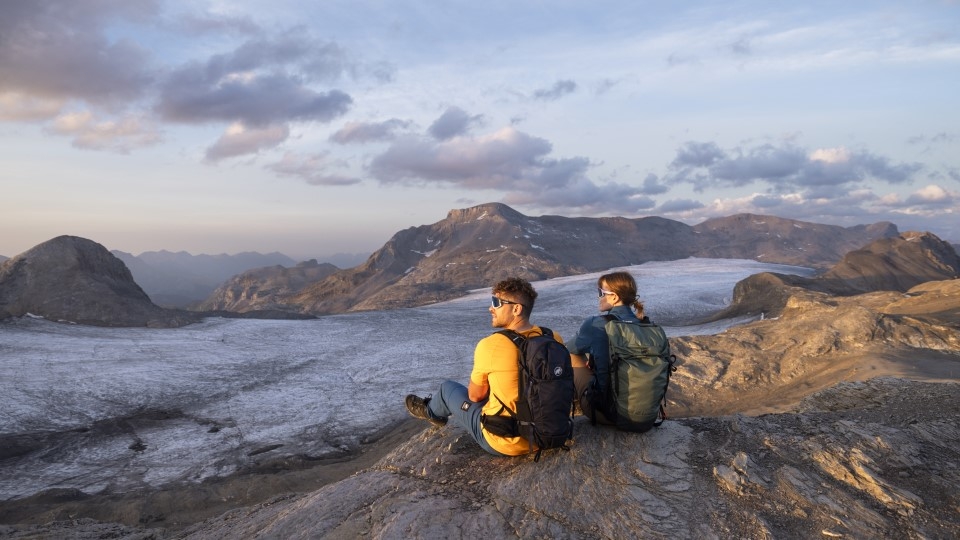
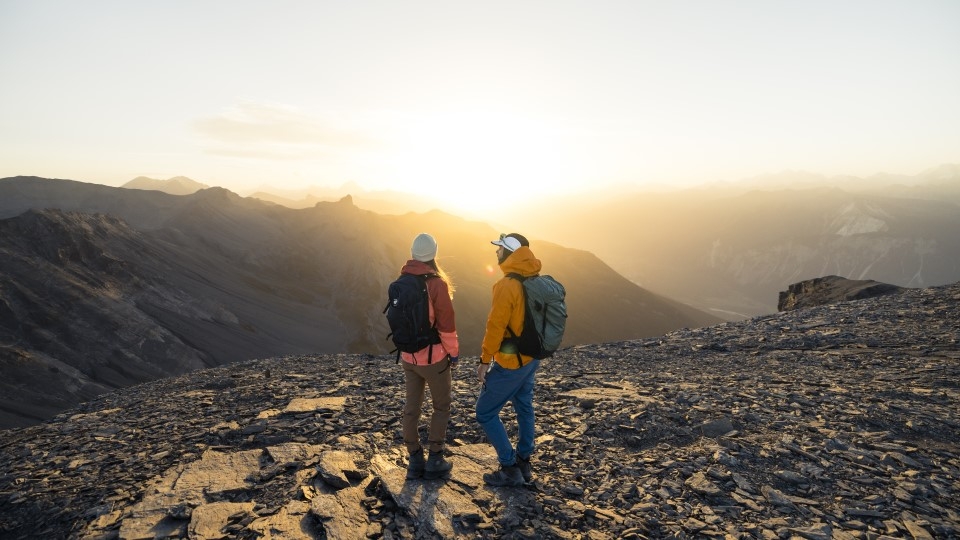
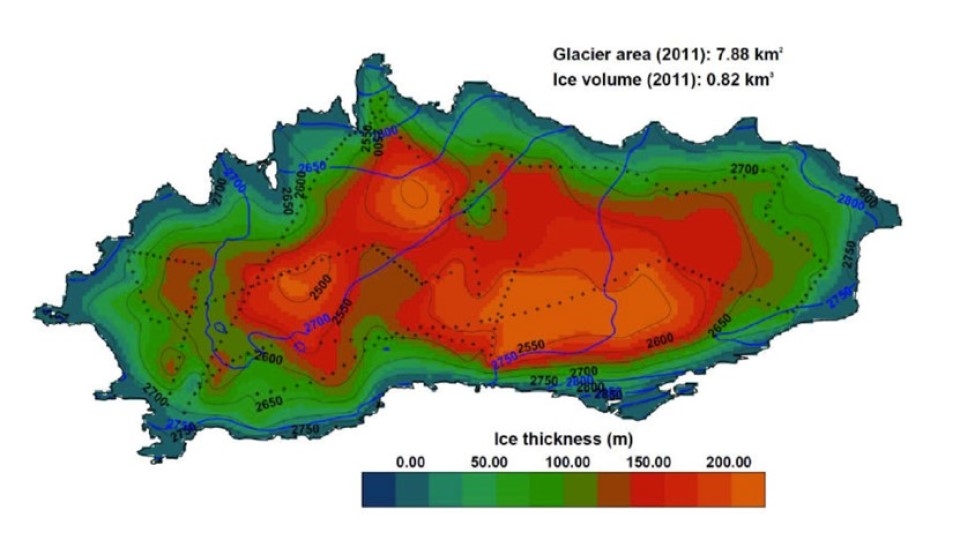
Today, the imposing mass of ice is melting, and fast, with no signs of slowing down. Will the Plaine Morte Glacier give way to mountain pastures? Or even a lake? The terrain hidden beneath the ice has been the focus of scientific models and three depressions could retain water to become lakes (highlighted in orange in the image). Maybe.
Literally: “Maybe” is the name given to this imaginary future lake, whether probable or improbable – the first lake in Switzerland’s history to be baptised before it even exists. After all, if the idea appeals, why not let it flourish in our hearts and minds? A poetic lake.
Those who climb the Plaine Morte Glacier cannot ignore the atmosphere that dominates this place. As soon as you leave the cable car station and head along the great crest stretching from north to south, the air suddenly feels lighter. Here, there are no dramatic precipices or “sublime horrors” to coin the term used by the Romantics to describe the rugged peaks of the Alps. A vastness awaits. Standing over a mineral world with your head in the clouds, the endless panoramic sky embraces the surrounding mountain tops.
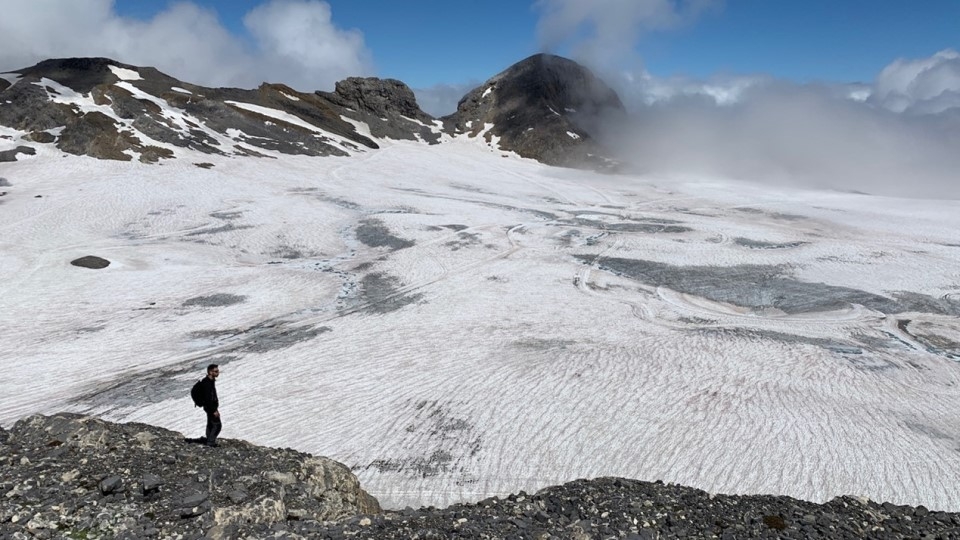
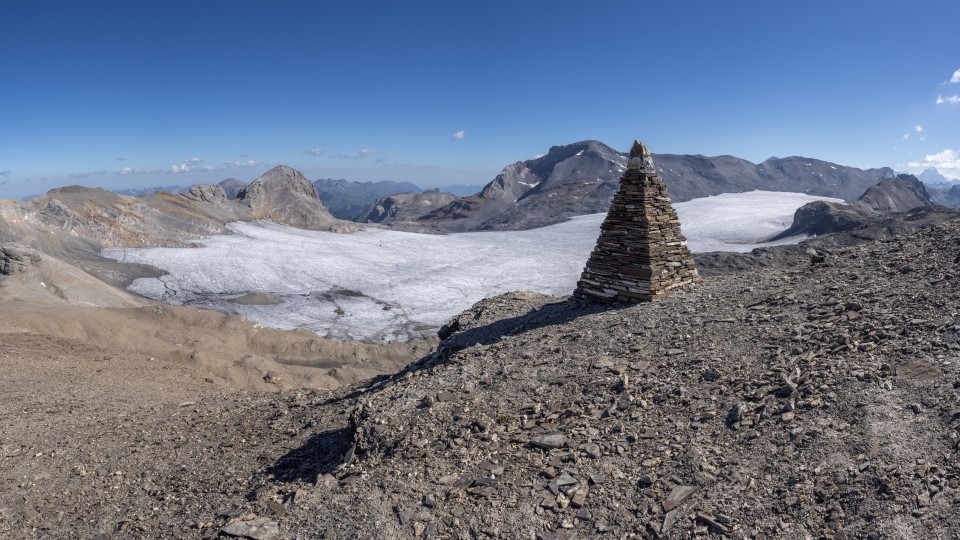
As if carried by the air, the stone and the sky, an Other Time governs these lands in all weathers.
Time in Plaine Morte moves at a different pace. Is it tainted by this somewhat sinister moniker? And yet, there is nothing morbid to be found. The wind and the elements are in constant movement, very much alive and just as invigorating. But time is an entirely different matter, an almost tactile texture.
This sensation envelopes you as the Funitel carries you to the summit. Beneath the lift’s long cables, surrounding the cabin suspended between the earth and the sky, you are suddenly transported from the frenetic time of the valley to the indifference of the high mountains.
This feeling becomes ever more apparent as you turn away from the cable car building to reach the summit and its weather mast just a few hundred metres away. Leaving the bustling station behind, the mountain unveils a whole new sense of time. Along the suspended walkways beneath the summit leading to the glacier, the stretching of time intensifies. At the glacier’s edge, it is almost palpable: distant sounds fade, almost imperceptible, while the crunch of footsteps is overwhelming. Finally, when you find yourself in the middle of the glacier (not to be attempted alone or without proper equipment), a captivating stillness settles over the cold ground. In the deafening silence, time itself seems to stop. A heavenly glow wraps itself around everything, the ethereal and the material.
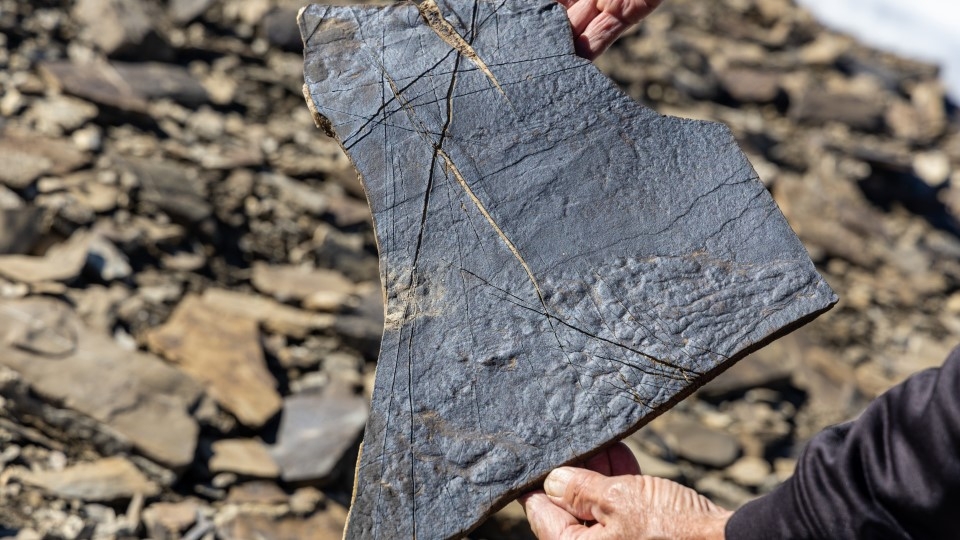
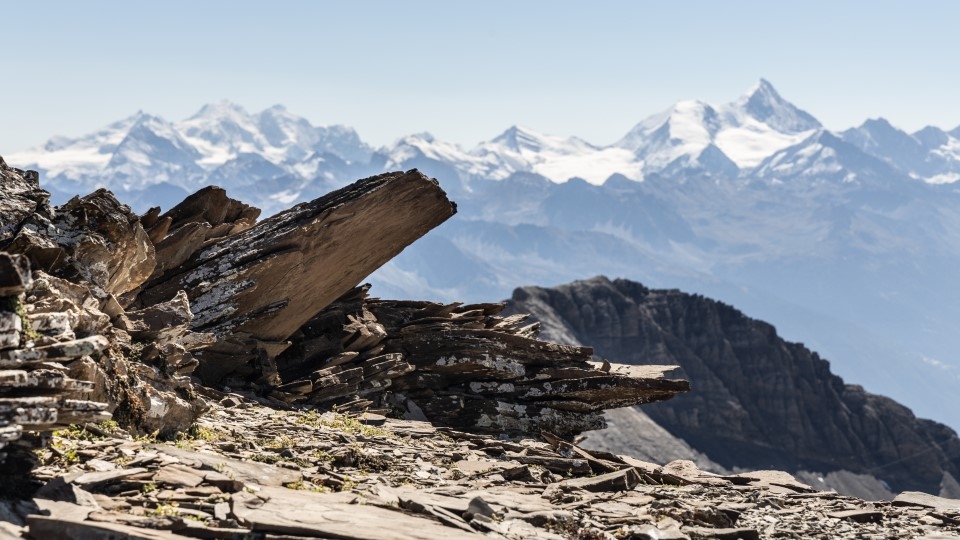
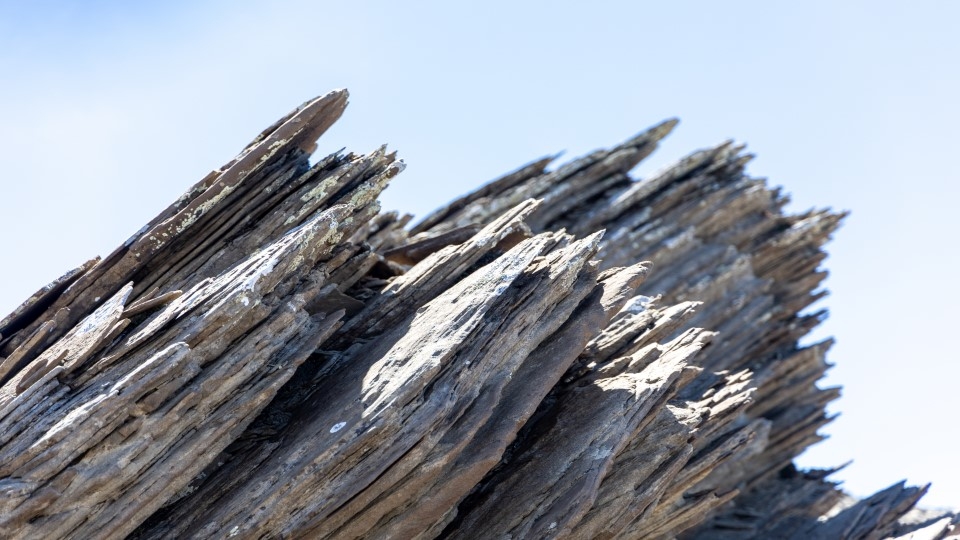
It is universal: every stone, every rock is a miraculous distillation of time, peacefully sitting there for hundreds of thousands and even millions of years on an outstretched palm. At Plaine Morte, in a timeless atmosphere, this feeling is amplified so powerfully that it almost becomes tangible.
At first glance, the landscape is desolate and lunar – uniform and grey. Nevertheless, those with a discerning eye will discover a fascinating diversity of rocks, formations and even colours, with blue and pearly reflections, ochre yellows, coffee tones, rosy crystals... and many more.
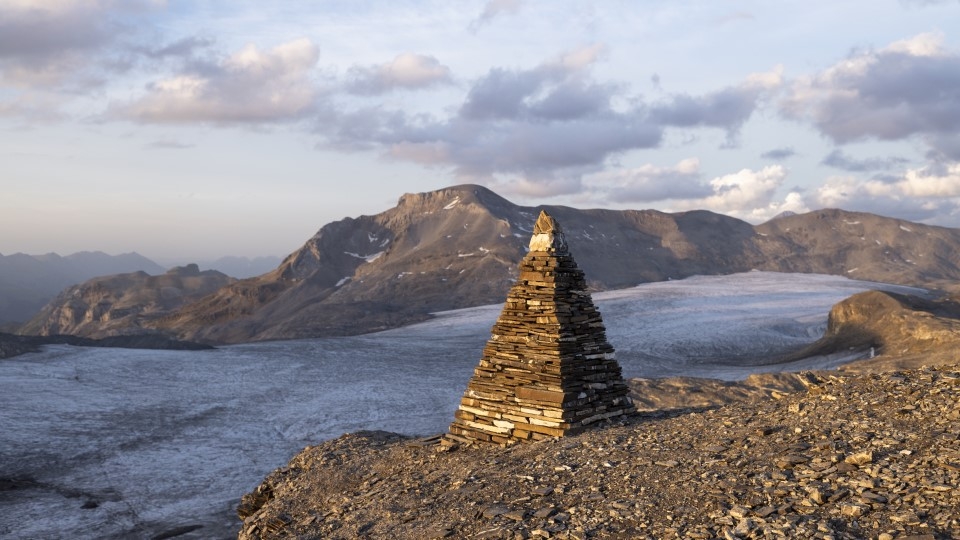
Layers of rocky millefeuilles jut out of the ground like half-open books. In the distance, enormous yet perfectly formed slabs seem to have been expertly sculpted into ready-made tabletops, rough yet smooth at the same time. More recently, these have been used to build cairns, piles of stones that guide the way, as humankind has done since the dawn of time. Descending towards the glacier, you pass alongside stretching furrows of time, protrusions of perfectly straight crystalline lines sandwiched between darker layers, only to be broken a few feet away. Millions of years swirl in the dust. In the silent isolation of Plaine Morte, these temporal markers are this Other Time, symbolised by the ancient forms of cairns along the Trail of an Other Time.

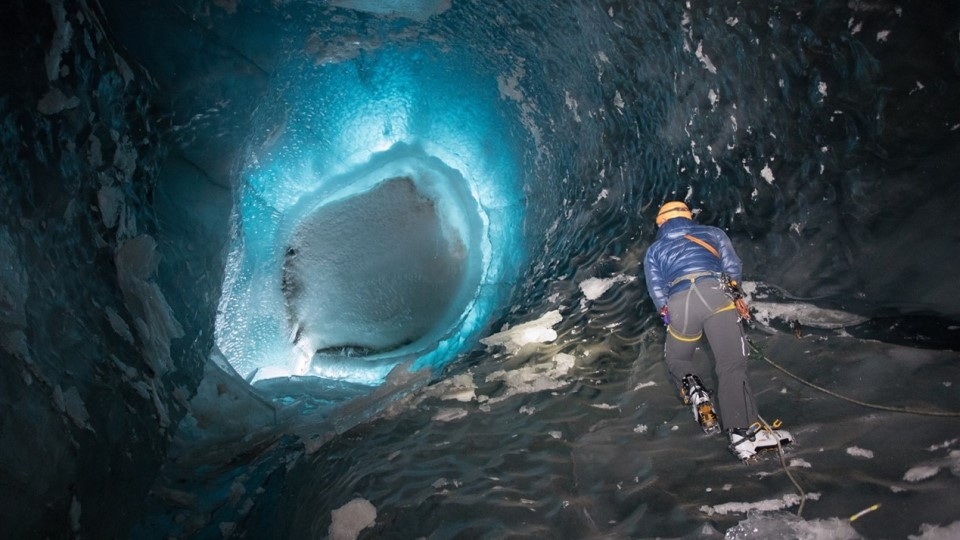
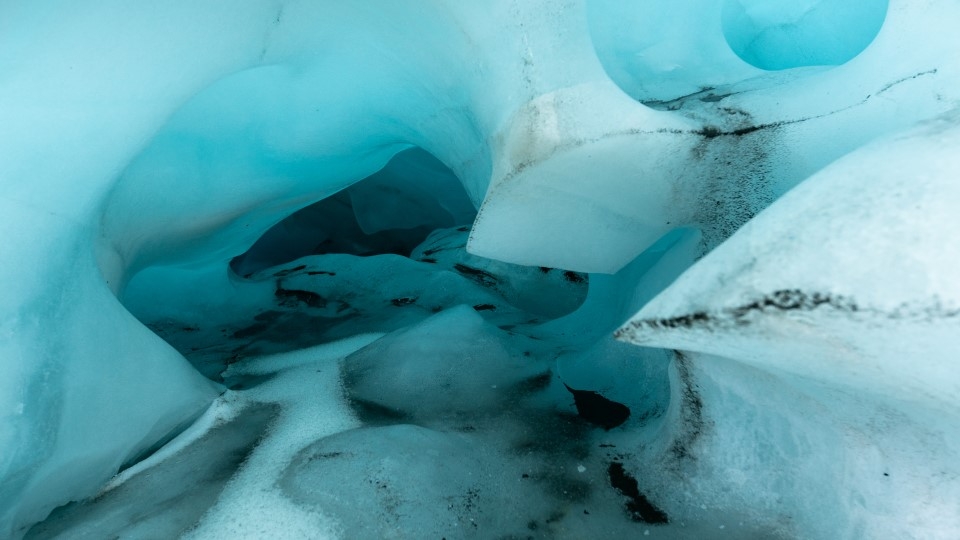
Try to picture the strange, invisible and largely inaccessible world of the plateau glacier’s entrails. They form a wondrous labyrinth of passages forged by water flowing through the ice, from countless small channels to vertical caverns as immense as they are majestic.
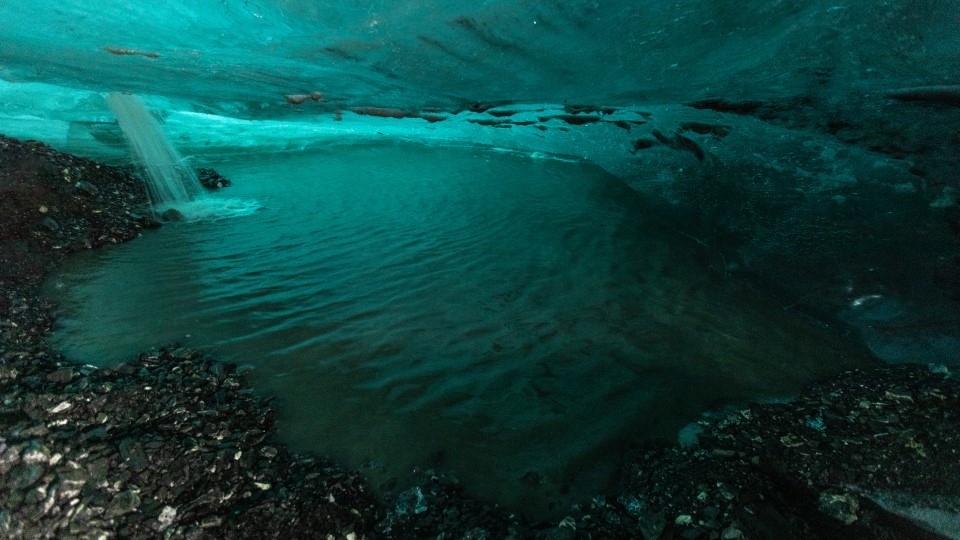
The meltwater begins by trickling along the glacier’s surface under the open sky, carving out blue-hued meanders. Suddenly, these luminescent streams disappear into ice shafts of various sizes, sculpted by water and known as moulins. There, hidden from view with only our imagination to guide us, the water embarks on a mysterious and powerful voyage, weaving through the glacier’s mass, eroding it. Constantly seeking until it can go no further, it bores its way through tunnels of every proportion. Nobody has a map of this network of passages, especially as they are constantly changing – no year is the same.
The largest moulins, however, remain for several years, acting as gateways into the underworld. But even then, there are only a few days a year, often in autumn, when the water stops gushing down in thundering torrents to allow a few experts, guides, speleologists and glaciologists to descend into the frozen abyss.
What they discover is a magical yet oppressive realm, where every shade of blue and grey has been trapped in an eternally inert world, which is simultaneously and extraordinarily alive, temporary and even fleeting. From the ephemeral drop of meltwater to the almost everlasting ice sheets that are tens of thousands of years old, every scale of time is concentrated in a single place, an Other Time.
Much of this water eventually leaves the glacier, flowing north towards Lenk-Simmental, while a fraction resurfaces in the form of springs in the Crans Montana region. Maybe one day, in the not-too-distant future, when the glaciers have all disappeared, this water will flow into the “Maybe” Lake.
It is a story that is only just beginning. Or rather, it is a story that has been told for thousands of millennia and you’ve only just become a part of it.
Immerse yourself in an Other Time. Come and discover this extraordinary place along the Trail of an Other Time.
Getting to the Plaine Morte summit
Take the Les Violettes Express ski lift (bus stop: Crans-Montana, télé Violettes), followed by the Les Violettes-Plaine Morte Funitel. Allow just over 30 minutes to get from Crans-Montana to Plaine Morte.
Dates and opening hours
As per the Les Violettes-Plaine Morte Funitel timetable.
Ticket prices
Plaine Morte stands at an altitude of almost 3,000 metres. An “Access 3000m” ticket or a Crans-Montana lift day pass is required.
All prices
My Explorer Card advantages
If you stay overnight in Crans-Montana, you will receive your personal My Explorer Card which includes free or reduced lift day passes (depending on the time of year).
More info and validity of the My Explorer Card


